



Article Repository


During the 19th century, Shri Premchand Roychand was a prominent personality in financial market in Mumbai (earlier known as Bombay). Born in 1831, he rose from a modest background to become a key player in the stock market, ultimately founding the ‘The Native Share and Stock Brokers Association (later known as Bombay Stock Exchange and now BSE). His career coincided with a period of economic growth in Mumbai, driven by factors like the American Civil War's impact on the cotton trade. Premchand's influence extended to banking and land reclamation projects, marking stages of prosperity. However, the end of the Civil War led to a financial downturn, and he faced criticism and financial ruin. Despite this, Premchand Roychand's legacy endures through his philanthropic contributions and the recognition of his impact on Mumbai’s development. A dedicated gallery in Chhatrapati Shivaji Maharaj Vastu Sangrahalaya, Mumbai, has been established in his honor. The University of Calcutta gives out an award in his name i.e. Premchand Roychand Award to an outstanding student in Master of Arts every year. The Rajabai clock tower in Mumbai is named after his beloved mother, Rajabai Roychand.
The BSE is the oldest stock exchange in Asia and its origins can be traced back to the 1850s. The establishment of the BSE was influenced by various factors related to trade and business in Bombay (now Mumbai), which was a prominent commercial centre during British rule in India.

The Ahmedabad Stock Exchange (ASE), the second oldest and one of the prominent regional stock exchanges in India, was established in 1894 and played an important role in facilitating the listing and trading of securities, particularly in Gujarat. The ASE was recognized by the Securities Contract (Regulations) Act, 1956, as a permanent exchange in 1982. However, similar to many other regional stock exchanges, it faced many challenges, such as its inability to evolve with technological advancements, increased competition from the NSE and BSE, and its dwindling trading volumes, post the advent of online trading systems. In 2018, the ASE was formally permitted by SEBI to exit the business of the stock exchange.
 Stock Market- A Historical Sketch.jpg)
Calcutta (now known as Kolkata), the political and commercial capital of British India till 1911, boasted a thriving stock market activity that served as the nation's first financial hub. The establishment of the Calcutta Stock Exchange (CSE) was a response to the growing need for an official stock exchange. During its heyday, Calcutta provided a plethora of trading opportunities through three distinct stock exchanges, namely the Calcutta Stock Exchange, the Bengal Share and Stock Exchange, the Stock Exchange Association of Bengal and informal exchanges at Gudri and Katni. However, with the change in time, only CSE continued its operations, and the other exchanges vanished/discontinued their operations. The CSE enjoyed the status of one of the most prominent stock exchanges for a long time and also modernised its operations with the introduction of electronic trading system. However, the challenges emerged from the payment crises of 2001 and the emergence of national-level electronic trading platforms offered by BSE and NSE, as a result of which CSE struggled to keep afloat. This eventually culminated in its trading suspension in 2013.
-A Historical Journey.jpg)
Madras Stock Exchange, established in 1920, was the first in the southern part of India. MSE played a notable role in the growth of industries in the southern region. By observing strict rules of conduct and ensuring high professional standards, MSE earned its esteem among the investing public as well as the entrepreneurs. In 1957, the Exchange registered itself under the Companies Act, 1955 and became a company limited by guarantee. The exchange was converted into a company limited by shares and obtained re-registration on November 18, 2005. MSE ensured to keep up with the technological advancements happening in the sphere of business. However, the expansion of national stock exchanges and the spread of their terminals all over India affected MSE, as did any other regional stock exchange. In 2001, MSE established its subsidiary company, MSE Financial Services Ltd. and acquired membership of NSE and BSE, through a provision provided by SEBI to the regional stock exchanges to revive their business. However, MSE decided to exit the stock exchange arena in 2014 and the same was stamped by the exit order passed by SEBI on May 14, 2015.
The Securities and Exchange Board of India was established in 1988 following recommendations from various committees and the need for regulatory oversight in the Indian capital markets
National Stock Exchange of India (NSE) was incorporated in November 1992 and was recognized as a stock exchange in April 1993 under the Securities Contracts Regulation Act, 1956. The NSE commenced its operations using an electronic trading platform for the wholesale debt market in 1994 and the cash market segment shortly thereafter.
The 1990s was a decade of significant change and transformation in India. This period witnessed economic liberalization, political developments, technological advancements, and cultural transitions.
 Limited.jpg)
In the era of technology and digitalization, the traditional methods of holding and transferring securities needed a revolutionary change. Depository systems emerged as a solution to facilitate seamless trading, settlement, and transfer of securities in a secure and efficient manner. This article delves into the inception and evolution of depository systems in India, with a specific focus on Central Depository Services (India) Limited (CDSL), a key player in the Indian capital market and a pioneer in providing convenient, dependable, and secured depository services.
.jpg)
Commodity derivatives trading is not a new concept in India, and it is as old as that in the other parts of the world. In India, the first organized futures market was the Bombay Cotton Trade Association Ltd., which was set up in 1875. By the early 20th century, there were several commodity futures exchanges trading in independent commodities like pepper, jute, turmeric, etc.
National Commodity and Derivatives Exchange (NCDEX) was incorporated in April 2003 and commenced its operations in December 2003. It offers commodity derivatives contracts for trading on diverse range of commodities such as turmeric, crude sunflower oil, kapas, jeera, guar seed, guargum, coriander, cotton seed oil cake, castor seed, steel long etc.
SEBI previously followed a two-step process for registering market intermediaries, involving initial and permanent registration. However, to streamline the process and reduce compliance costs, SEBI decided to grant a one-step permanent registration to market intermediaries like merchant bankers, registrar to an issue and share transfer agent, bankers to an issue, underwriters, credit rating agencies, debenture trustees, depository participants, and KYC registration agencies.
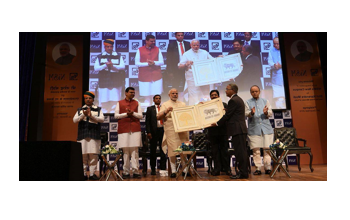
The NISM campus at Patalganga, inaugurated by Prime Minister Narendra Modi in 2016, is a state-of-the-art facility spread across 70 acres. It can accommodate up to 5,000 students and features modern classrooms, a 400-seater auditorium, a library, an amphitheatre, and a recreational block. The NISM campus at Patalganga was inaugurated by Prime Minister Narendra Modi on December 24, 2016. The occasion was also graced by many dignitaries, including the Governor of Maharashtra, Union Finance Minister, Chief Minister of Maharashtra, Minister of State for Finance and regulators from Malaysia, Bangladesh, Japan, Iran and Sri Lanka and former chairmen of SEBI. Having the potential to accommodate 5,000 students, the new 70 acre state-of-the-art campus is green, energy efficient and environment friendly. Among the main features of the campus are modern classrooms equipped with the latest technology, a 400 seater auditorium, a library, an amphi-theatre and a recreational block. For further details, please see the https://www.nism.ac.in/.
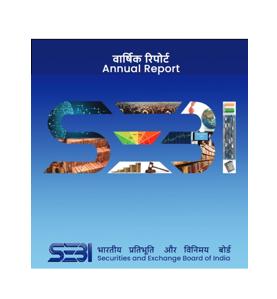
Following is the collection various annual reports of Indian Securities Market. The annual report may be downloaded from the link provided.

Following is the collection various NISM Study Material of Indian Securities Market. The NISM Study Material may be downloaded from the provided pdfs.
Following is the collection various Handbook of Statistics of Indian Securities Market. The Handbook of Statistics may be downloaded from the link provided.
The article explores SEBI's role in fostering the growth of the Indian securities market through transformative reforms, including derivatives trading, dematerialization, insider trading regulations, and the introduction of various investment products.
The article traces the evolution of SEBI from its conceptualization in the G.S. Patel Committee Report, 1985 to its establishment in the year 1988, its empowerment through legislation as a statutory body in the year 1992 and beyond. Accordingly, this article highlights the salient features of Acts such as the SEBI Act, 1992, the Depositories Act, 1996, the Securities Contracts [Regulation] Act, 1956, and the Companies Act, 2013. The article also delves into the details of the important legislative empowerment of SEBI through legislative amendments in the years 1995, 1999, 2002, 2004, 2014, 2015 and 2019.