Last updated on 9 Nov 2025, 7:53 pm
Scroll Down for Main Content
Read • View • Watch
Read Articles
View Images
Watch Videos
Interviews
Informative Videos
Infographic Images
View All
Markets
Evolution of Regulatory Framework for SMEs
Small and Medium Enterprises (SMEs) play a critical role in India’s economic growth, employment generation and innovation. Recognising the need to provide SMEs with efficient access to capital markets while balancing investor protection, SEBI introduced a dedicated regulatory framework for SME fundraising in 2010. Over the years, the framework has evolved through regulations, guidelines, circulars and periodic reviews covering SME exchanges, market making, listing norms, institutional trading platforms and governance standards. The latest review in 2025 reflects SEBI’s continued efforts to strengthen the SME ecosystem in line with the growing maturity of India’s capital markets.
Mutual Fund Lite: A New Chapter in India’s Mutual Fund Regulation
Introduced to simplify and streamline the launch and management of passively managed mutual fund schemes, the Mutual Fund Lite (MF Lite) framework launched in 2024-25, adopted a proportionate regulatory approach aligned with the lower-risk nature of passive funds. This initiative aimed to make passive investing more accessible and cost-effective for both investors and asset management companies (AMCs).
Events
test
Evolution of Rights Issue Framework
SEBI has progressively transformed the rights issue framework to make it a faster, simpler and more investor-friendly mode of capital raising while preserving the pre-emptive rights of existing shareholders. The reforms culminated in the 2025 amendments, which reduced the rights issue timeline to just 23 working days, introduced greater operational flexibility and strengthened transparency and investor protection.
Specialized Investment Funds: Bridging the Gap Between Mutual Funds and Portfolio Management Services
A new investment product called the Specialized Investment Fund (SIF) has been introduced to provide sophisticated investors with greater investment flexibility while retaining the regulatory safeguards of the mutual fund (MF) system. The SIF aims to bridge the regulatory gap between mutual funds and portfolio management services (PMS) by offering enhanced portfolio flexibility under regulatory oversight.
Regulations
Flexibility in Framework for Voluntary Delisting
Voluntary delisting refers to the process through which a listed company seeks to remove its equity shares from a recognized stock exchange, subject to regulatory safeguards that ensure fair treatment of its public shareholders. Since delisting deprives investors of future trading opportunities on the stock exchange, the regulatory framework has been progressively strengthened to ensure transparency, fair price discovery and an equitable exit mechanism. Beginning with administrative guidelines in 1998, the framework has evolved through expert committee recommendations, consultation papers, Board deliberations and regulatory amendments into a comprehensive principles-based regime under the SEBI (Delisting of Equity Shares) regulations.
Personalities and Institutions
Reform Markets
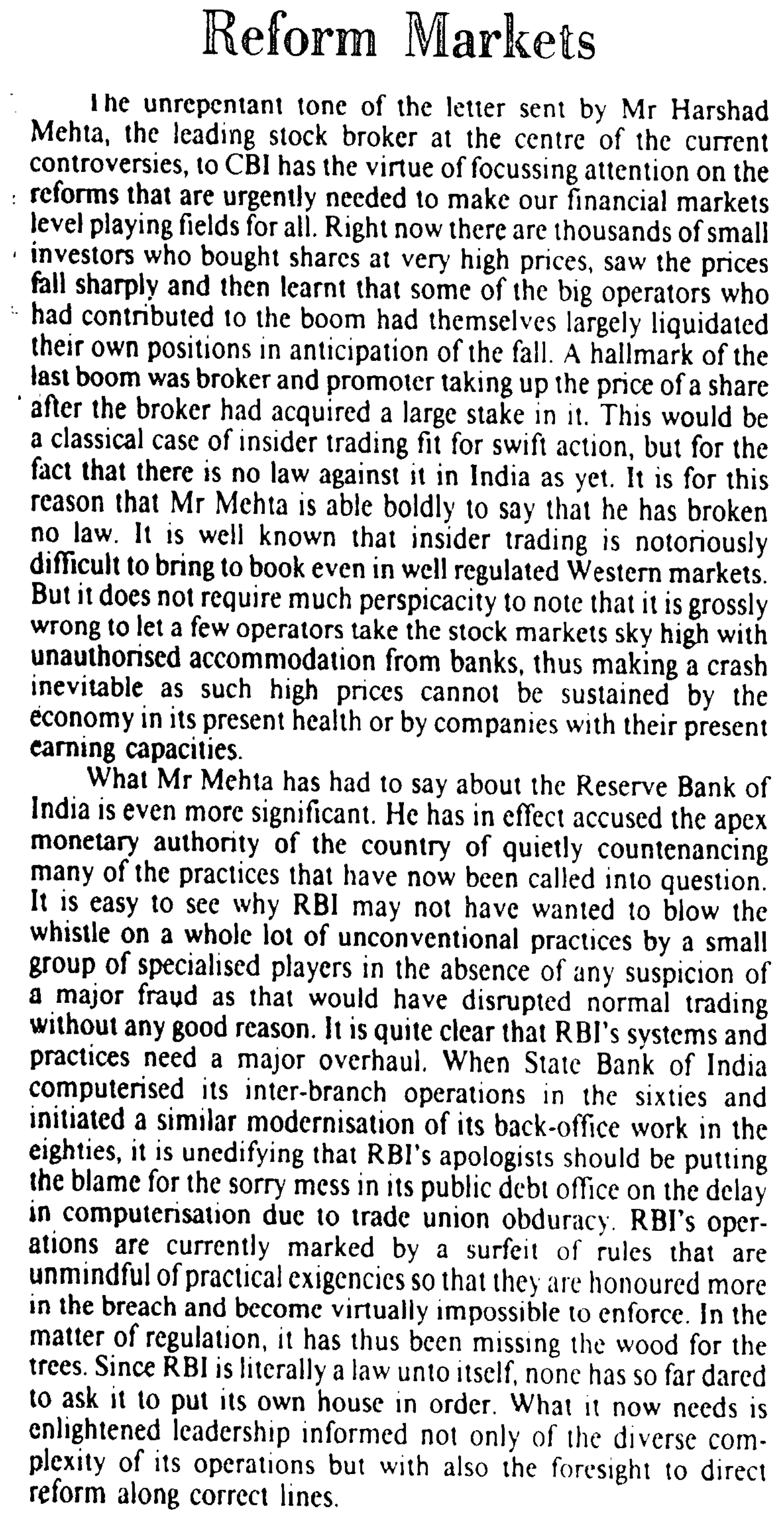
The unrepentant tone of the letter sent by Mr. Harshad Mehta to the CBI focuses attention on reforms urgently needed to make financial markets level playing fields for all. While big operators liquidated positions before prices fell, India lacks laws against such insider trading, allowing operators to take markets sky high with unauthorised bank accommodation. Furthermore, Mr. Mehta accused the Reserve Bank of India of quietly countenancing unconventional practices now called into question. What is now needed is enlightened leadership with the foresight to direct reform along correct lines
Role of financial institutions
Development finance institutions have played a constructive role in establishing India's industrial base. However, these institutions seem to have moved away from their developmental role and are getting entangled deeper in management and control of private sector industries. Corporate circles have been pleading for a re-examination of the role and appointment of nominee directors to avoid day-to-day interference in company operations. Furthermore, some argue that financial institutions should keep their funds rolling by disposing of shares with a ready market. The concept of growth or mutual funds has yet to take root in the country, but such funds could prove successful in mobilising and canalising community savings for industrial development.
Rules framed for stock dealers-
The Securities and Exchange Board of India (SEBI) has framed rules to register and regulate stock dealers, share shoppes, and unauthorised stock exchanges under Section 12 of the SEBI Act. These rules are proposed with a view to redressing the grievances of investors in semi-urban and rural areas who have been experiencing difficulties in getting services for disposal of securities or consolidating odd lots. The regulations impose a statutory duty on stock dealers to deal only on a spot delivery basis and issue receipts in a specified form. Additionally, every applicant eligible for grant of a certificate must pay an initial fee of Rs 50,000 to keep the certificate in force. Stock dealers will have to submit information relating to their activities as and when required by SEBI.
Securities contract rules amended
The government has amended the Securities Contracts (Regulation) Rules, 1957, to allow a company to become a member of a stock exchange if it satisfies certain conditions. The conditions are that the company is formed in compliance with the provisions of section 322 of the Companies Act, that a majority of the directors are shareholders of the company and members of the stock exchange, and that the directors have "unlimited liability" in the company. Under the amended rules, notified in the Gazette of India Extraordinary, the stock exchanges would admit these members on the recommendations of several financial institutions, including the Industrial Finance Corporation and the Industrial Development Bank of India
SEBI's initiative
Initiated by SEBI in 2024, Dharohar is a pioneering initiative blending India's securities market history with digital innovation, offering an immersive, sustainable journey through economic knowledge and history.