




Article Repository


SEBI laid down a framework for an electronic book mechanism (EBM) for issuing debt securities on a private placement basis in order to streamline procedures and enhance transparency in discovering prices.

The corporate bond market in India is largely institutional and OTC-based, with SEBI mandating trade reporting on platforms provided by NSE, BSE, FIMMDA (phased out), and MSEI. A Trade Repository for corporate bonds aims to consolidate trade data, enhancing post-trade transparency and providing valuable information on pricing, yield, volume, maturities, and credit migrations. SEBI's phased implementation covered integration of secondary market data (Phase I) and integration of data across primary and secondary markets (Phase II) to provide a comprehensive view to market participants.

Category I and Category II FPIs were given the option to directly access corporate bond markets without brokers, as has been allowed to banks, insurance companies, pension funds, etc.
To streamline the issuance procedures for debt securities on a private placement basis and to enhance transparency and price discovery, SEBI mandated the use of an Electronic Book Mechanism (EBM) starting July 01, 2016, for issuing debt securities in the primary market. Furthermore, in January 2018, SEBI released comprehensive guidelines on EBM for private placement, which replaced the earlier guidelines issued in April 2016.
In order to make the then existing process of issuance of debt securities, NCRPS and SDIs easier, simpler and more cost effective for both issuers and investors, the time taken for listing after the closure of the issue was reduced to 6 working days as against the extant requirement of 12 working days.

As a measure to broaden the access of non-resident investors to debt instruments in India, Foreign Portfolio Investors (FPI) are permitted to invest in municipal bonds.

SEBI vide various circulars had prescribed the guidelines on valuation of money market and debt securities. On September 24, 2019, SEBI issued a circular reviewing the existing provisions made in various circulars in order to align these guidelines with best practices and improve the robustness of the valuation of money market and debt securities

With the twin intentions of ensuring investor protection and developing a larger market for CPs, SEBI introduced a framework for listing CPs to provide a transparent and disclosure-based regime.
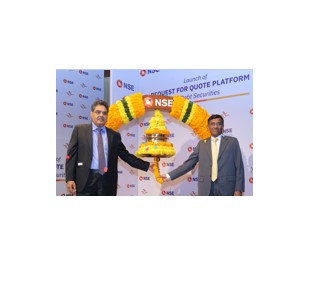
To bring in transparency in the bilaterally negotiated ‘Over the Counter’ deals and to improve liquidity and price discovery in the corporate bond market in India, BSE and NSE have launched their Request for Quote (RFQ) platforms. RFQ is an electronic platform that enables multilateral negotiations to take place on a centralized online trading platform with straight through processing of clearing and settlement to complete trades. These platforms act as single interface for price givers and price takers in the debt market from a diverse set of clients, which can result in better price discovery and bring pre-trade transparency to the transactions of eligible securities.

Additional Tier-1 (AT-1) bonds are a type of perpetual bond issued by banks and non-banking finance companies to raise capital and comply with Basel III norms. SEBI vide circular, dated October 6, 2023, issued guidelines for issuance, listing and trading of perpetual non-cumulative preference shares and innovative perpetual debt instruments / perpetual debt instruments (commonly referred to as additional tier 1 (AT 1) instruments or bonds).

The government of India approved the Guarantee Scheme for Corporate Debt (GSCD) to provide a guarantee cover for the debt raised by the Corporate Debt Market Development Fund (CDMDF), which aims to stabilise the corporate bond market during times of stress. Accordingly, SEBI issued guidelines for the operation and management of the scheme and for the fund to act as a backstop facility for the purchase of investment grade corporate debt securities. A backstop facility in the stock market means a financial agreement or arrangement that creates a supplementary source of funds if the original source of funds fails to satisfy the essential demand, thereby being a last-resort support.
SEBI issued a circular on the Review of Norms regarding Investment in Debt Instruments with Special Features and the Valuation of Perpetual Bonds on March 10, 2021. Perpetual bonds or Additional Tier I Bonds are issued without any maturity date but are usually issued with call option(s) and qualify for Tier I capital. Banks have been the majority issuers of perpetual bonds.
SEBI mandated the classification of debt schemes based on a risk-class matrix, reflecting the maximum risk fund managers can undertake in schemes. Effective from December 01, 2021, this matrix considers parameters like Macaulay Duration for interest rate risk and credit risk value for credit risk.

To standardise the usage of rating scales, Credit Rating Agencies (CRA) were advised to align their rating scales with the rating scales prescribed under the guidelines of the respective financial sector regulator or authority in terms of Regulation 9(f) of SEBI CRA Regulations, or in the absence of the same, to follow rating scales prescribed by the Board from time to time. Further, a seven-point Expected Loss (EL)-based rating scale was introduced to be used by CRAs for ratings of projects/ instruments associated with the infrastructure sector to begin with.

In order to enhance ease of doing business and to give impetus to the secondary market for corporate bonds through increased participation and enhancement of liquidity, SEBI in August 2021 prescribed provisions pertaining to the denomination of issuance and trading of non-convertible securities and also reduced the face value of each debt security or non-convertible redeemable preference share issued on a private placement basis from ₹10 lakh to ₹1 lakh vide circular dated October 28, 2022.
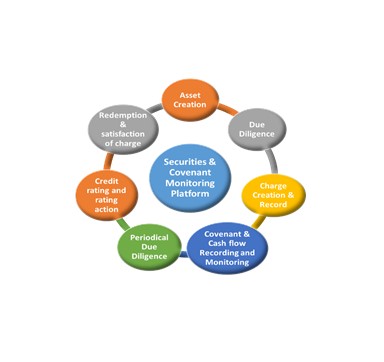
With the objectives of strengthening the process of security creation and monitoring of security created, asset cover and covenants of non-convertible securities, a platform for 'Security and Covenant Monitoring System' hosted and maintained using distributed ledger technology (DLT) was proposed to be developed by depositories.

NCS Regulations, 2021, were amended to provide a regulatory framework for Online Bond Platform Providers (OBPPs). Such platforms possess huge potential for reaching out to a wider set of investors, especially retail and non-institutional investors. Therefore, the framework is aimed at bringing such platforms within the regulatory ambit, by requiring the OBPPs to register as stock brokers in the debt segment of the stock exchanges.

In the backdrop of increasing interest in sustainable finance around the globe, SEBI reviewed the regulatory framework pertaining to green debt securities. The scope of the definition of green debt security was enhanced by including new modes of sustainable finance in relation to pollution prevention and control, eco–efficient products, etc., and the concept of blue, yellow and transition bonds was introduced. Further, the regulatory framework for green debt securities was strengthened, laying out the responsibilities of the issuers of such securities and asking issuers to appoint a third-party reviewer for the post-issue management of the use of proceeds, to undertake and disclose impact reporting in line with the updated Green Bond Principles recognized by IOSCO.

In order to enhance liquidity in the bond market and also to provide investors with opportunity to hedge their positions, a framework has been prescribed to permit stock exchanges to introduce derivative contracts on indices of corporate debt securities rated AA+ and above. To start with, the stock exchanges are permitted to launch futures contracts on corporate bond indices, subject to certain conditions.
The Government of India (GoI) approved the Guarantee Scheme for Corporate Debt (GSCD) to provide a guarantee cover for the debt raised by the Corporate Debt Market Development Fund (CDMDF) that aims to stabilise the corporate bond market during times of stress. Accordingly, SEBI issued guidelines for the operation and management of the scheme and the fund to act as a backstop facility for the purchase of investment grade corporate debt securities.