




Article Repository

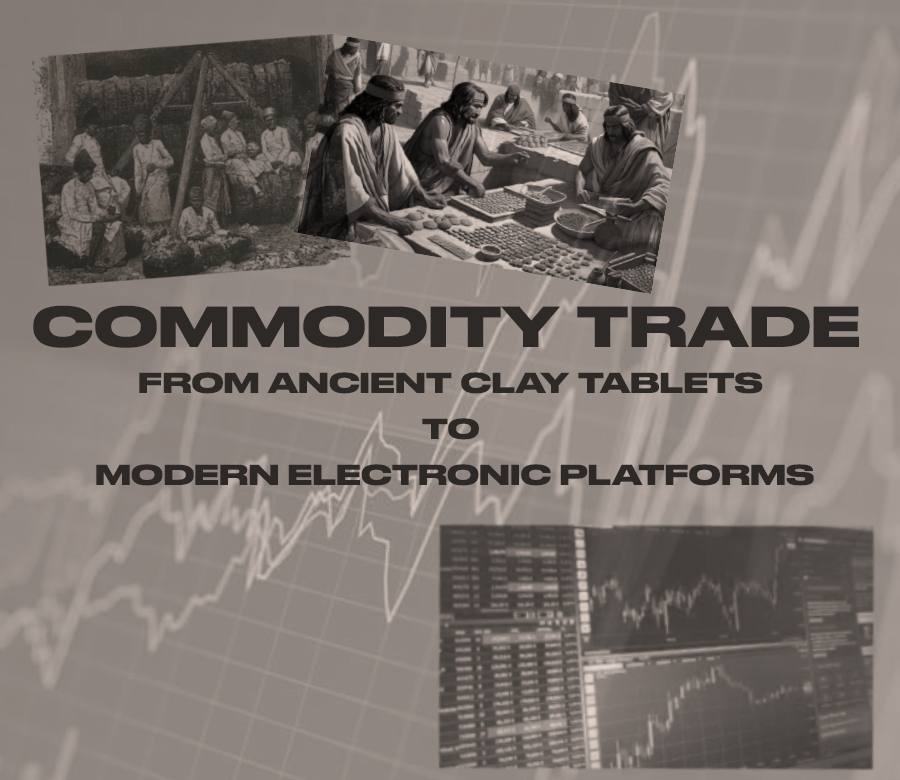
The commodity trading has witnessed transformative shifts over the centuries. Ancient Mesopotamian clay tablet contracts established the foundation for commodity derivatives. Historical developments, from Japan's Dojima Rice Exchange to Chicago's CBOT, shaped commodity markets. In modern India, trading occurs on electronic platforms of recognized exchanges, namely MCX, NCDEX, NSE and BSE. The Emergence of nation-wide electronic trading facilities offered by national-level exchanges and certain regulatory requirements led to the closure of smaller or commodity specific exchanges. Over a period, the market regulator, (earlier Forward Market Commission and now SEBI) introduced several measures from time to time to deepen and broaden the market.

This article explores the celebrated history of the Calcutta jute industry, tracing its roots, its hegemony in the world markets and its decline. Starting in 1855 with the Acland Mill in Rishra, Bengal, the jute industry experienced significant growth under the managing agency system. The Indian Jute Manufacturers Association (IJMA), formed in 1884, fuelled the prosperity of the industry until the end of World War I. The article goes on to explain how Calcutta outstripped Dundee and Scotland to become the capital of the global jute markets and the ensuing boom in the jute shares market. It also discusses how the emergence of jute substitutes, the age-old policies of IJMA and finally the partition of British India led the industry onto the path of decline. The article concludes by emphasizing the potential of jute as a sustainable and eco-friendly crop that could play a significant role in the world of tomorrow.

Over the centuries, commodity trading has evolved from the barter system to spot markets to derivatives markets. In commodity spot markets, traders sell goods such as rice for immediate delivery against cash. At some stage, counterparties needed to enter into agreements to deliver commodities (eg, rice) at a specified time in future at a price agreed today. These agreements came to be known as forward contracts. For example, on April 1, a seller agreed to sell rice of specific quantity for delivery on a future specified date say July 31 to the buyer at pre-decided price, the contract will be honoured by both the parties, irrespective of prevailing price of rice on July 31.

SEBI issued guidelines on product design and risk management framework for options in the commodity derivatives market in June 2017. In the Budget Speech for the year 2016-17, the Hon’ble Finance Minister had, inter-alia proposed that “new derivatives products will be developed by SEBI in the Commodity Derivatives Market”. The introduction of new products into the commodity derivatives markets has been the subject of deliberation at various forums, as it is considered conducive for the overall development of the commodity derivatives market, by attracting broad-based and institutional participation, enhancing liquidity, facilitating hedging and bringing more depth to the commodity derivatives market. The issue of new products in the commodity derivatives market was discussed by the commodity derivatives advisory committee (CDAC) and its sub-groups. The recommendations made by the CDAC inter alia, on the subject of introduction of new products was considered by SEBI. Further, in order to allow commodity derivatives exchanges to offer new products, a consultation paper on amendments to the Stock Exchanges and Clearing Corporations (SECC) Regulations was floated for public comments. After public consultation and on the basis of approval accorded by the SEBI Board, necessary amendments to the SECC Regulations were published in the Gazette on May 29, 2017. Accordingly, necessary guidelines were issued on product design and risk management framework for options in the commodity derivatives market in June 2017, which inter alia included the following:- • Underlying of the options contract shall be commodity future which is amongst top five contracts in terms of turnover subject to minimum threshold turnover. • On a pilot basis each exchange was allowed to launch options on futures on only one commodity. • On exercise, options positions shall devolve into underlying futures position. For further details, please see the SEBI circular SEBI/HO/CDMRD/DMP/CIR/P/104 dated September 28, 2016.
In order to promote institutional participation in the Exchange Traded Commodity Derivatives (ETCDs), SEBI has permitted Category III Alternative Investment Funds, Eligible Foreign Entities and Mutual Funds to participate in ETCDs. In furtherance to this objective, SEBI has given its nod for the participation of portfolio managers in ETCDs on behalf of their clients.

Introduction of new commodity derivative products is considered conducive to the overall development of the commodity derivatives market as it helps in attracting broad-based participation, enhances liquidity, facilitates hedging and brings in more depth to the commodity derivatives market. In the Union Budget Speech for the year 2016-17, The Finance Minister announced that new derivatives products will be developed by SEBI in the Commodity Derivatives Market. Pursuant to this, SEBI permitted recognized stock exchanges with commodity derivative segments to introduce futures on commodity indices and issued guidelines for the design of commodity indices and product design for futures on commodity indices.

SEBI prescribed guidelines for the Liquidity Enhancement Scheme in commodity derivatives contracts in March 2018, subject to certain conditions stipulated vide April 2014 circular. However, since an exchange in nascent stage of business may not be able to generate profits or have free reserves from business operations, SEBI, vide circular dated July 26, 2019, has exempted such exchanges from above mentioned guidelines and prescribed new guidelines with respect to the incentives under the liquidity enhancement scheme.
Following the merger of the Forward Markets Commission (FMC) with SEBI, SEBI issued a circular on September 21, 2016 to consolidate and update the norms prescribed for National Derivatives Exchanges by the erstwhile FMC. However, it was observed that there is no uniformity in the length of staggered delivery periods for commodity futures contracts across exchanges, even for the same commodities. Based on the representations received from exchanges and further deliberations in the Commodity Derivatives Advisory Committee (CDAC), SEBI brought in the revised norms for staggered delivery via a circular dated July 26, 2019.
SEBI, in consultation with Commodity Derivatives Advisory Committee (CDAC) and vide Circular SEBI/HO/CDMRD/DMP/CIR/P/104 dated September 28, 2016, issued guidelines for trading of options in Commodity Derivatives Market. Initially, ‘Options’ were permitted for trading on only on those commodity futures as underlying, which are traded on exchange platforms with some specific criteria. Thereafter, the government notification dated October 18, 2019, paved the way for introduction of ‘options on Goods’. Accordingly, SEBI vide circular dated January 16, 2020, issued necessary guidelines on product design and risk management framework to operationalize ‘Options on Goods’ in the commodity derivatives market in addition to ‘Options on Commodity Futures’.

In the Union Budget 2021-22, the Hon'ble Finance Minister announced the setting up of a Gold Spot Exchange and that SEBI would be the designated regulator for the proposed gold exchanges. Accordingly, SEBI proposed a regulatory framework for the gold exchanges in India and SEBI (Vault Managers) Regulation, 2021 to operationalise the gold exchanges and trading of EGRs in India. The broad specifications for EGR contracts were issued, enabling stock exchanges to introduce diverse denominations. These initiatives aim to enhance transparency and efficiency in India's gold market.
SEBI permitted the launch of options on commodity indices, leading to an expansion of the range of available commodity derivative products. The detailed framework on product design and comprehensive risk management was issued vide circular dated March 24, 2022.

In order to promote institutional participation in Exchange Traded Commodity Derivatives (ETCDs) and based on representations received for enabling Direct Market Access (DMA) facility to FPIs in ETCDs and deliberations by Commodity Derivatives Advisory Committee(CDAC) of SEBI, SEBI allowed stock exchanges to extend DMA facility to FPIs for participation in ETCDs subject to certain conditions prescribed vide circular dated September 29, 2022

Subsequent to the representations received from stock exchanges and due deliberations by the Commodity Derivatives Advisory Committee (CDAC) to enhance the depth of the commodity derivatives market, the earlier list of 91 goods notified under clause (bc) of Section 2 of SCRA vide MoF’s earlier notification dated September 27, 2016 was expanded to 104 commodities vide MoF notification dated March 01, 2024. The revised list now encompasses an additional 13 goods, which include alloys for five metals.